Eccuis
The Three MusketeersEccuis is a small village on the route toward Rouen, remembered in the narrative as a practical relay point during d'Artagnan's desperate return to Paris. Its single tavern, the Shield of France, provides him with a fresh horse and allows the journey to continue at speed, making the village a modest but essential link in the chain of secrecy, mobility, and military obligation that drives the episode.
Setting and Route
Eccuis lies along the road that d'Artagnan is instructed to take after leaving the city with Paris kept to his right. The directions are precise: he is to stop at the village's only tavern, the Shield of France, and not to judge the establishment by its appearance. The warning emphasizes the location's functional character. Eccuis is not presented as a destination or a place of political importance, but as a concealed stage in a route whose value depends on speed, discretion, and reliable supplies.
The village is also bound to a password system. When d'Artagnan asks whether he must use the same password, he is told that he must. This detail places Eccuis within an organized network rather than treating it as an accidental roadside stop. The password turns an ordinary tavern into a controlled point of contact, where a traveler can be recognized and assisted without exposing the larger operation.
The Relay During d'Artagnan's Ride
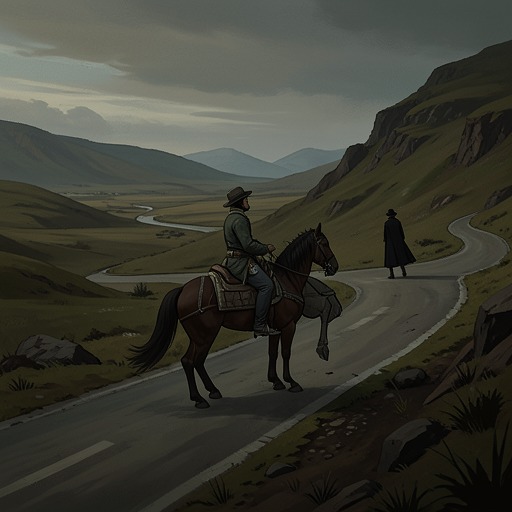
At Eccuis, the expected scene is repeated. D'Artagnan finds a provident host and a fresh horse, just as the instructions promised. He leaves his address as he had done at the previous stopping place and immediately sets off again at the same pace for Pontoise. The village therefore supplies not comfort but continuity: its innkeeper preserves the rhythm of the mission by replacing the exhausted mount before the journey loses momentum.
The episode gives Eccuis a sharply defined narrative function. D'Artagnan is not merely traveling; he is passing through a succession of prepared stations that convert urgency into measurable progress. Eccuis is one of the points at which the invisible infrastructure of the journey becomes visible through a host, a stable, a password, and a horse. The modesty of the setting heightens the scale of the achievement, since the final result depends on these small, coordinated provisions.
Connection with Paris and the Mission
After leaving Eccuis, d'Artagnan continues to Pontoise, where he changes his horse for the last time, and then reaches M. de Treville's hotel at nine o'clock. He has covered nearly sixty leagues in a little more than twelve hours. Eccuis thus belongs to the decisive final stretch of a ride whose success is confirmed by his immediate reception: M. de Treville treats him as though he had seen him that very morning and informs him that Dessessart's company is on duty at the Louvre, where d'Artagnan can return directly to his post.
The village's consequence is therefore institutional as well as physical. By helping d'Artagnan arrive in time, Eccuis contributes to his restoration to active service. The stop links the rural road to the royal and military center of Paris, showing how a seemingly insignificant locality can participate in the movements of the King's Musketeers and in the preservation of the larger political plot.
Narrative Significance
Eccuis exemplifies the novel's recurring contrast between grand events and the practical details that make them possible. Elsewhere, the narrative turns to the Siege of La Rochelle, the political struggle surrounding the Huguenot stronghold, and the confrontation between France and England. Yet the same world also depends on a village with one tavern, a host who knows what to do, and a horse waiting in the stable.
The place also clarifies the material conditions of adventure. D'Artagnan's progress is sustained by animals, roads, coded recognition, and prepared hospitality rather than by courage alone. His journey gains its legendary speed through a sequence of ordinary services rendered at the right moment. Eccuis consequently functions as a miniature of the novel's broader political machinery: beneath military campaigns, royal commands, secret letters, and personal rivalries lies a network of local agents whose reliability turns intention into action.